
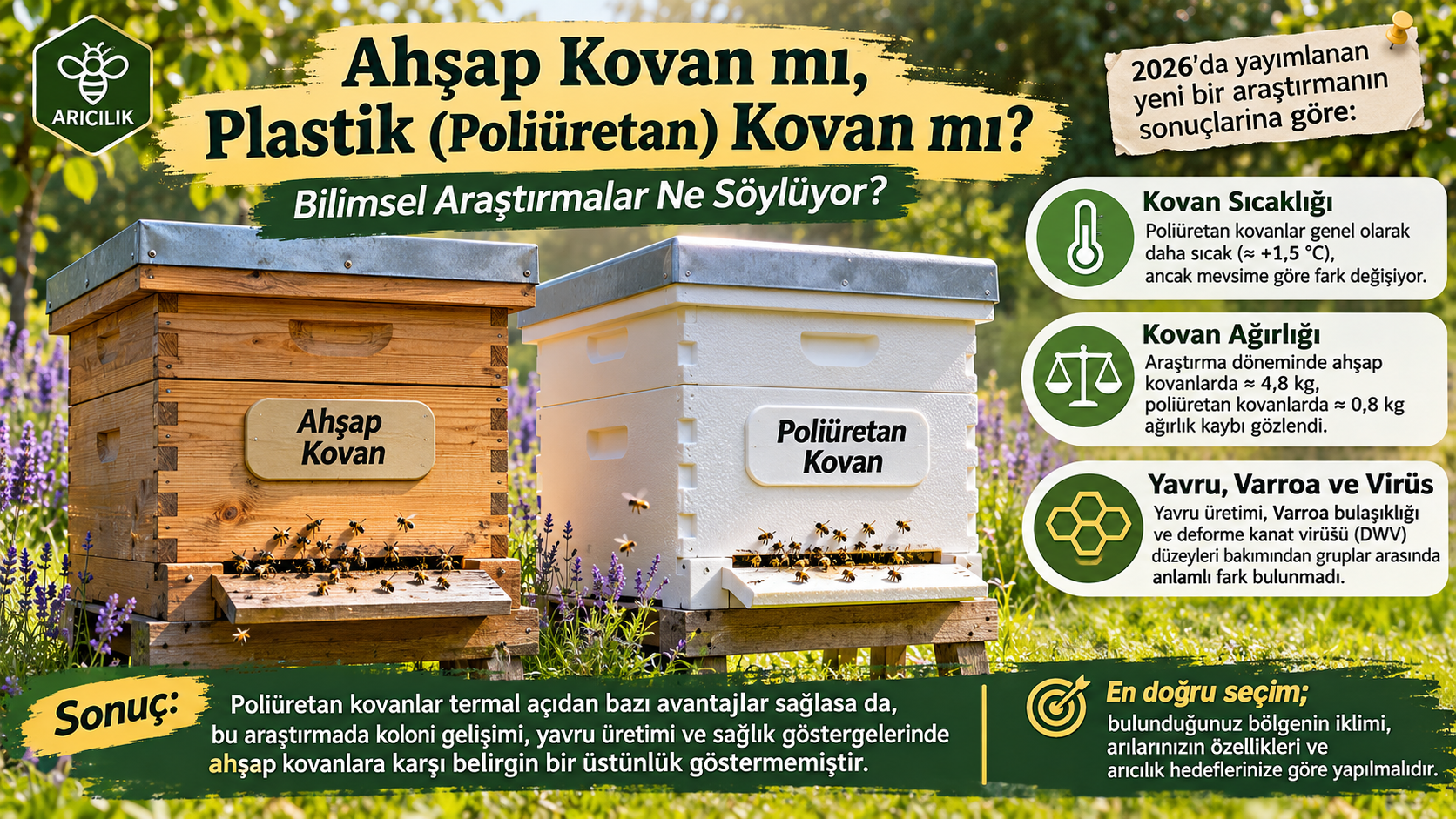
A study published in 2026 compared wooden and polyurethane beehives in terms of temperature, relative humidity, brood production, Varroa infestation, and colony weight.
Beehives made from polyurethane and polystyrene are becoming increasingly common alternatives to traditional wooden hives. Interest in these materials is driven particularly by their potential to provide better thermal insulation and reduce the energy required for colonies to regulate temperature.
But the key question for beekeepers is: Does a better-insulated hive necessarily produce a stronger, healthier, and more productive honey bee colony?
A 2026 study by Mohamed Alburaki and colleagues at the United States Department of Agriculture (USDA-ARS), published in the Journal of Economic Entomology, offers important insights into this question.
How do honey bees regulate hive temperature?
Honey bees generally maintain the temperature of their brood combs at approximately 34–35 °C. This range is important for egg, larval, and pupal development. Conditions inside the colony may also influence the physiological development of young workers and their acquisition of flight capabilities. When the weather is cold, workers generate heat through their flight muscles and cluster together to limit heat loss. In hot weather, they ventilate the hive, collect water, and promote evaporative cooling. These activities require energy and worker effort. A well-insulated hive can reduce heat exchange between its interior and the outside environment and may therefore help reduce the colony’s thermoregulatory energy expenditure, particularly during cold periods. An important distinction, however, is that the overall temperature inside a hive is not necessarily the same as the temperature of its brood combs. Workers can regulate the brood area more precisely than other parts of the hive.
How was the study conducted?
Researchers compared 20 honey bee colonies at the Beltsville research apiary in Maryland, USA. Ten colonies were housed in traditional wooden Langstroth hives and ten in polyurethane hives. The general hive configurations were similar, and colony sizes were kept comparable at the beginning of the experiment. Initially, each hive contained four brood frames, two frames with honey and pollen, and four empty frames. The study lasted approximately six months. Electronic sensors recorded internal temperature, relative humidity, and hive weight every hour. During the experiment, colonies received no sugar syrup, no honey was harvested, and no Varroa treatments were applied. In October, the researchers counted capped brood cells, measured Varroa infestation, and investigated deformed wing virus (DWV) levels using molecular methods.
1. Are polyurethane hives warmer?
Across the entire study period, the reported mean internal temperature was 34.3 °C in polyurethane hives and 32.8 °C in wooden hives. This difference of approximately 1.5 °C was statistically significant. However, the seasonal results tell a more nuanced story. During summer, mean temperatures were 35.1 °C in polyurethane hives and 34.8 °C in wooden hives—a difference of only 0.3 °C. In autumn, the pattern reversed, with wooden hives recording higher temperatures than polyurethane hives. Thus, polyurethane hives were not necessarily warmer in every season. Moreover, a higher temperature is not always better. During heatwaves, factors such as sun exposure, roof construction, and ventilation are also important.
What this means for beekeepers: Hive selection should take account of both summer and winter conditions in the local climate, rather than insulation properties alone.
2. Which hive performs better in terms of humidity?
Mean relative humidity was 57.2% in polyurethane hives and 60.2% in wooden hives. Wooden hives had higher relative humidity in both summer and autumn. This does not necessarily mean that polyurethane hives provide a healthier humidity environment, however. Relative humidity depends on temperature: even when the amount of water vapour in the air remains unchanged, relative humidity can fall as temperature rises. Humidity also serves important biological functions within the colony, including brood development, nectar ripening, and water balance. A lower humidity reading alone is therefore insufficient to determine which hive is better.
3. Polyurethane hives showed less weight loss
One of the most striking findings concerned hive weight. Over the study period, wooden hives lost approximately 4.8 kg, compared with 0.8 kg in polyurethane hives. The difference was statistically significant. This finding suggests a potential advantage for polyurethane hives in terms of colony energy economy, but changes in hive weight do not directly measure energy expenditure or honey savings. Hive weight is influenced by more than honey consumption: nectar intake, adult bee population, honey and pollen stores, and other colony components all contribute. It would therefore be incorrect to conclude that polyurethane hives directly saved 4 kg of honey. Establishing such a benefit would require separate measurements of honey consumption and colony population.
4. Why did warmer hives not produce significantly more brood?
Brood production was among the most important outcomes for practical beekeeping. In October, researchers recorded approximately 1,273 capped brood cells in polyurethane hives and 1,024 in wooden hives. Although the polyurethane group had a numerically higher count, the difference was not statistically significant (p = 0.60). Why might this be? Brood production depends on many factors beyond temperature, including queen laying capacity, worker population, pollen availability, nectar flow, season, and colony health. Workers may also maintain suitable brood-nest temperatures despite differences in hive material. Consequently, a higher overall hive temperature does not necessarily translate into increased brood production. An important limitation is that brood production was measured only once, in October. The study therefore cannot tell us whether polyurethane hives accelerate brood development in spring or provide an advantage during extreme summer heat.
Key finding: The potentially more favourable thermal conditions in polyurethane hives were not accompanied by a statistically significant increase in brood production in this study.
5. Were there differences in Varroa infestation or deformed wing virus?
Varroa infestation was 5.1% in polyurethane hives and 5.4% in wooden hives. No statistically significant difference was detected between the two groups in deformed wing virus (DWV) levels either. This finding matters because it might be assumed that a modest increase in hive temperature could suppress Varroa populations. In this study, however, the observed temperature differences were not associated with a statistically significant reduction in Varroa infestation. Experimental heat treatments targeting Varroa generally involve substantially higher temperatures applied for defined periods. These treatments should not be confused with the modest temperature differences resulting from normal hive insulation. Polyurethane hives therefore cannot replace Varroa management, and the study did not demonstrate a reduction in DWV infection attributable to polyurethane hives.
6. Could the bees’ genetic characteristics affect the results?
The researchers also examined mitochondrial DNA and identified four haplotypes associated with genetic groups related to Apis mellifera ligustica, A. m. carnica, and A. m. mellifera. Colonies carrying different haplotypes showed differences in thermoregulation and weight. This suggests that not all colonies respond identically, even when housed in the same type of hive. However, mitochondrial DNA does not represent a colony’s entire genetic background, and some haplotypes were represented by very few colonies. It would therefore be premature to claim that any particular honey bee subspecies consistently performs better in wooden or polyurethane hives.
7. Do other scientific studies support these findings?
An earlier study by Alburaki and Corona, published in 2021, reported that polyurethane hives provided better winter insulation than wooden hives. This suggests that hive material can be especially important in cold weather. Another study published in 2024, comparing Langstroth and Warré hives, found that hive type affected internal temperature and humidity, but a more stable microclimate did not translate into superior performance across all colony indicators. A laboratory study published in 2024 also demonstrated that the insulation of wooden hives could be improved using materials such as fungal-based insulation and wood fibres.
Better thermal performance does not necessarily require a plastic hive. The design and insulation of wooden hives can also be improved.
A modelling study published by Derek Mitchell in 2024 further indicated that natural tree cavities and conventional man-made hives may differ in their heat-transfer characteristics. This highlights the importance not only of material, but also of hive geometry, wall thickness, and internal cavities.
8. Which hive is more suitable for the Thrace region?
In Thrace, northwestern Türkiye, honey bee colonies may face high temperatures in summer and cold, windy conditions in winter. It is therefore difficult to identify the best year-round hive using measurements from only one season.
A comparison of standard wooden Langstroth hives, polyurethane Langstroth hives, and wooden hives with improved insulation would be scientifically valuable in this region. Such research should monitor not only hive temperature, but also brood area, adult bee population, honey and pollen reserves, Varroa infestation, overwintering success, and honey yield. Sun exposure, ventilation, and the genetic origins of colonies should also be controlled as far as possible.
Conclusion: Which hive is better?
The 2026 study by Alburaki and colleagues demonstrated that polyurethane and wooden hives can differ in their internal temperature and humidity conditions, and that polyurethane hives experienced less weight loss during the study period. However, no statistically significant advantage was identified for brood production, Varroa infestation, or DWV levels. The available evidence is therefore insufficient to conclude that polyurethane hives outperform wooden hives across all biological and economic indicators. Improving the insulation of wooden hives also remains a promising alternative.
The ideal beehive of the future will be defined not simply by whether it is made of wood or plastic, but by how well it meets the thermoregulatory needs of honey bees—and how those conditions affect colony health, development, and productivity.
When evaluating hive performance, we should consider not only the temperature inside the hive, but also the biological performance of the colony living in it.
References
Alburaki, M., Madella, S., Chan, P., & Corona, M. (2026). Implications of the hive materials and mtDNA haplotypes on honey bee Apis mellifera thermoregulation and colony weight. Journal of Economic Entomology. https://doi.org/10.1093/jee/toag031
Alburaki, M., & Corona, M. (2021). Polyurethane honey bee hives provide better winter insulation than wooden hives. Journal of Apicultural Research, 61, 190–196. https://doi.org/10.1080/00218839.2021.1999578
Kutby, R., Baer-Imhoof, B., Robinson, S., Porter, L., & Baer, B. (2024). The effect of hive type on colony homeostasis and performance in the honey bee (Apis mellifera). Insects, 15(10), 800. https://doi.org/10.3390/insects15100800
Sanz, M. C., Prado-Jimeno, R., & Fuentes-Pérez, J. F. (2024). Comparative study of natural fibres to improve insulation in wooden beehives using sensor networks. Applied Sciences, 14(13), 5760. https://doi.org/10.3390/app14135760
Mitchell, D. M. (2024). Are man-made hives valid thermal surrogates for natural honey bee nests (Apis mellifera)? Journal of Thermal Biology, 122, 103882. https://doi.org/10.1016/j.jtherbio.2024.103882
Note: This article aims to communicate scientific findings to beekeepers in an accessible way. Results obtained under particular climatic and management conditions should not automatically be assumed to apply elsewhere.

Bir yanıt yazın